WMWORLD MODEL MECHANISMS
PHYSICSPREDICTIVE SHORTCUTSCAUSAL CONTROL

Causal Writability in Video Models

A Chosen Future
Can Still Be Rewritten.

When appearance cues conflict with physical history, which training-supported continuation controls generation, and does the rejected continuation remain causally accessible within the model?

View the evidence Decoded-video measurements · causal interventions · cross-run transfer
CENTRAL FINDING
Physical structure can remain causally available without controlling natural generation.

Natural generation identifies the selected continuation; intervention identifies alternative continuations that remain causally accessible.

selectionavailabilitycausal authority
704

decoded futures in the 64 × 11 cue sweep

23 / 26

endpoint shortcut failures corrected at the purple cue

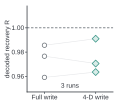
4-D

compact route retaining nearly the full causal effect

6 / 6

successful directed transfers across run pairs

01

MECHANISTIC OVERVIEW

A shortcut can dominate while
an alternative future remains writable.

The analysis separates behavioral selection, causal accessibility, commitment with depth, and downstream realization.

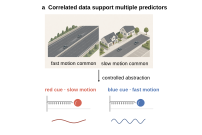
Natural contexts in which motion and appearance are correlatedFull resolution ↗
FIGURE 1A · TRAINING STRUCTURE

Natural correlations support predictive shortcuts

Context, motion, and future appearance are correlated in the training distribution, permitting appearance-based prediction without exclusive reliance on physical history.
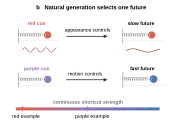
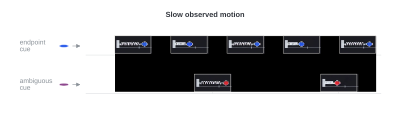
Appearance cue varied while physical history is held fixedFull resolution ↗
FIGURE 1B · CONTROLLED CONFLICT

Cue conflict reveals solution choice

Physical history is held fixed while the appearance cue is varied continuously. The decoded continuation can switch between shortcut-consistent and history-consistent modes.

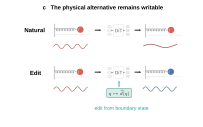
State-conditioned edit changing the decoded futureFull resolution ↗
FIGURE 1C · CAUSAL INTERVENTION

Internal edits recover the rejected continuation

A state-conditioned internal edit changes the final decoded motion, establishing a causal effect on generation rather than a correlational probe readout.

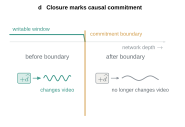
Condition keys and values writing the selected future into target statesFull resolution ↗
FIGURE 1D · COMMITMENT

Condition-to-target writes close causal writeability

A future is writable while condition-side intervention can redirect it. Commitment occurs when condition-to-target writes make the same intervention ineffective at subsequent depths.

02

NATURAL SOLUTION SELECTION

Cue strength selects among
training-supported continuations.

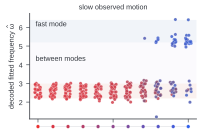
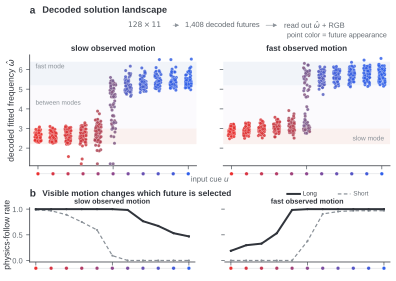
Fitted frequency and future RGB are measured directly from decoded rollouts. The trajectory, rather than the individual cue-conditioned rollout, is the statistical unit.

FIGURE 2A · SLOW HISTORY

Selection under slow physical evidence

As the input cue changes from red to blue, decoded futures move from the slow mode through an intermediate region toward the fast mode.

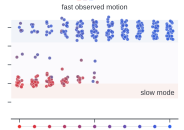
Decoded cue sweep for slow physical histories
FIGURE 2A · FAST HISTORY

Selection under fast physical evidence

The corresponding sweep under fast history separates the effect of cue strength from the direction of the physical evidence.

Decoded cue sweep for fast physical histories
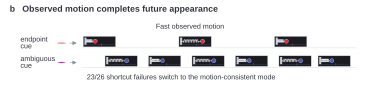
88.5%23 OF 26 ENDPOINT FAILURES

switch to the history-consistent frequency at the purple cue: 8/10 fast histories and 15/16 slow histories.

ESTIMAND

Conditional correction among endpoint shortcut failures

The denominator contains trajectories for which the strongly conflicting endpoint already produces the shortcut-associated frequency. This quantity is not an unconditional accuracy estimate.

Matched decoded examples showing joint changes in motion and appearanceFull resolution ↗
FIGURE 2B · MATCHED EXAMPLES

Motion and appearance switch jointly

With physical history and future window fixed, changing only the cue alters both fitted frequency and generated appearance. The selected object is therefore a joint appearance–dynamics continuation.

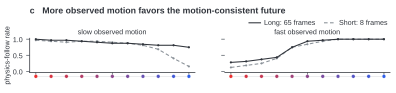
Short versus long history controlFull resolution ↗
FIGURE 2C · HISTORY CONTROL

Longer histories resist stronger conflicting cues

Long histories retain physics-consistent behavior under stronger cue conflict than short histories, providing a same-seed control for the strength of physical evidence.

DECODED ROLLOUTS

Matched behavioral comparisons

These are natural generations. Within each pair, physical history, generation seed, and future window are fixed; only the appearance cue changes.

Same fast physical history; only the appearance cue changes.

Same slow physical history; only the appearance cue changes.

03

STATE-STRUCTURED CAUSAL CONTROL

A compact route can be called
without a held-out donor.

Matched replacement identifies the writable route; low-rank analysis and a fit-only controller then test whether the route can be synthesized prospectively.

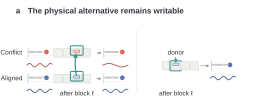
Matched state replacement recovering the rejected continuationFull resolution ↗
FIGURE 3A · MATCHED REPLACEMENT

Matched state replacement recovers the rejected future

Replacing the receiver state with the matched target difference recovers the alternative continuation and identifies a functional route site. Donor activations are used only for route discovery.

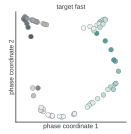
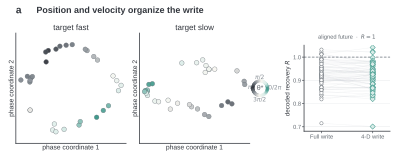
FIGURE 3B · TARGET FAST

Fast-route coordinates vary with boundary phase

Fast-route coordinates organized by boundary phase

The frozen coordinates trace a smooth phase-dependent family.

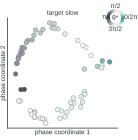
FIGURE 3B · TARGET SLOW

Slow-route coordinates form a complementary family

Slow-route coordinates organized by boundary phase

The opposite target direction remains structured by the same low-order boundary variables.

FIGURE 3B · LOW-RANK EFFECT

Four coordinates retain nearly full recovery

Recovery retained by a four-dimensional edit

The four-dimensional edit approaches the decoded effect of the complete matched difference.

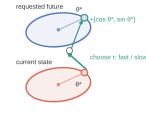
Fit-only boundary-phase controller
FIGURE 3C · CONTROLLERDirection chooses the route; phase locates the state

For each requested direction, the controller uses [1, cos θ*, sin θ*] to predict the top-four route coordinates from input-boundary phase.

HELD-OUT INTERVENTION

Prospective control without donor activations

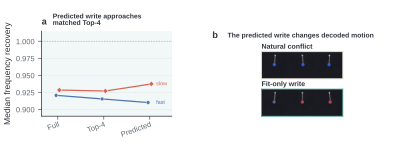
After fitting and freezing the controller, a requested target direction and held-out boundary phase are sufficient to synthesize the condition-state edit. Held-out coordinate R² is .83–.88, compared with .51–.60 for direction alone.

R = .99decoded recovery in the illustrated held-out replay
Held-out decoded replay after controller intervention
FIGURE 3C · DECODED EFFECTThe alternative continuation is recovered

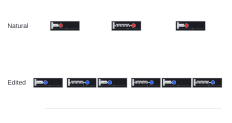
The intervention changes the final pixel trajectory under fixed receiver input and noise.

HELD-OUT ROLLOUT

Natural and intervened generation

The same held-out receiver, noise, and future window are used. The fit-only controller changes only the condition prefix at the frozen rewrite site.

The same fit-only PCA basis projects held-out raw activations and matched differences. B6, seed 3408, 50K; 128 fit pairs and 128 held-out pairs. Color denotes decoded frequency, with aligned frequency used for differences.

04

CAUSAL WRITEABILITY

Writeability predicts fate
as training consolidates a future.

Layerwise intervention profiles quantify where a selected future remains causally revisable.

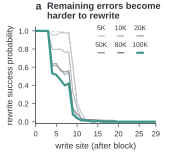
Writeability contraction over training
FIGURE 4A · TRAINING

Writeability contracts with training

The depth range over which intervention redirects shortcut failures becomes progressively narrower.

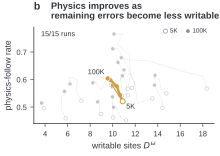
Physics-following improves while remaining errors become less writable
FIGURE 4B · TRAINING TRAJECTORIES

Better behavior, less writable remaining errors

Across 15 seeds, mean full-grid physics-follow rate rises from .52 to .60 while remaining-error writability falls from 10.88 to 9.55 sites between 5K and 100K.

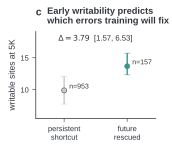
Early writeability predicting later error fate
FIGURE 4C · PROSPECTIVE FATE

Early writeability predicts subsequent correction

Failures later corrected by training (n = 157) are writable at 3.79 [1.57, 6.53] more sites than persistent failures (n = 953).

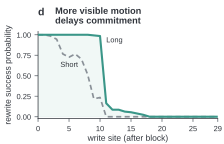
Short versus long history writeability profiles
FIGURE 4D · HISTORY CONTROL

Long histories remain writable at greater depth

The effect appears in all three matched-seed 50K comparisons. Short and Long use checkpoint-local strict banks, not trajectory-paired banks.

05

DOWNSTREAM CAUSAL AUTHORITY

Condition K/V writes
realize the selected future.

Target-route persistence, cross-run transfer, and path restoration localize how the shared route acquires downstream authority.

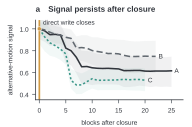
Target-route response after direct writeability closes
FIGURE 6A · PERSISTENCE

The target-route signal persists after direct rewrite closes

Route-aligned target responses remain measurable after condition-side frequency writeability has closed.

Cross-run causal coordinate transfer
FIGURE 3D · CROSS-RUN TRANSFER

Causal coordinates transfer across independent runs

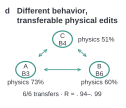
All six directed run-pair transfers achieve decoded recovery R = .94–.99 using fit-only scale and rotation.

Restoration of conflict keys and values erasing causal recoveryFull resolution ↗
FIGURE 6B · PATH RESTORATION

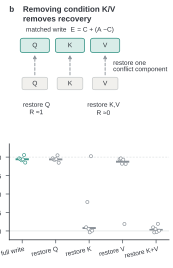
Restoring conflict K/V erases recovery

Within a successful matched edit, restoring conflict K or K+V reduces final recovery to approximately zero, whereas restoring Q leaves recovery near one. The causal bottleneck is therefore localized to condition-to-target key/value writes.

Dose response of a single value-head interventionFull resolution ↗
FIGURE 6C · SINGLE-HEAD INTERVENTION

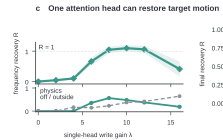
One value head exhibits a finite causal margin

Changing one of nine condition-token value heads yields a continuous dose response. Clean physics peaks at gain 8; continuous frequency recovery can overshoot at larger gains and increasingly leave the supported modes.

BOTTLENECK INTERVENTION

Decoded causal effect

The same selection-clean receiver and future window are used; only condition-token V in head 8 is edited.

GENERATION TIME · APPENDIX FIGURE 31

When the write acts matters

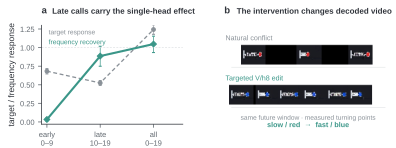
Network depth tells us where a write acts within one forward pass. Video generation also unfolds over 20 flow-matching calls, each passing through the network again. We therefore test when the same physical write can influence the final video.

Here, early and late refer to the first and second halves of the denoising sequence, not training checkpoints, network layers, or the first and second halves of the generated video.

On the same 48 trajectories, early calls 0–9 produce an internal response but little decoded recovery; late calls 10–19 recover motion, and all calls 0–19 improve recovery further.
The same gain-8 condition-V/head-8 write is applied to the same 48 receivers. Early-only writing changes the internal route response but is nearly ineffective in the decoded motion. Late-call writing restores motion; writing over all calls improves recovery further. An internal response alone does not establish control over the final generation. Figure 31 and methods ↗
Temporal-window control

In a separate 16-receiver comparison, neither calls 10–14 nor calls 15–19 rescues motion alone, whereas their joint 10–19 window does. The result is not simply “edit the last few steps”: it identifies an effective late window for this intervention. These tests do not establish a universal timing rule for every model, task or write.

06

SECOND-SYSTEM REPLICATION

The same causal abstraction
appears in Pendulum.

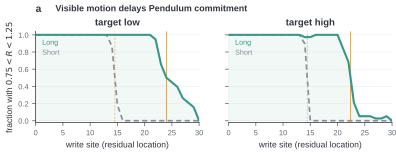
Appearance and physical history compete in decoded rollouts, while low-order boundary state predicts a donor-free edit that recovers held-out dynamics.

NATURAL CUE CHANGE

Endpoint conflict versus ambiguous cue

Physical history, trajectory, renderer, generation seed, and future window are fixed. Only cue appearance changes.

Endpoint conflictred cue · shortcut-associated slow/red future
Ambiguous cuepurple cue · history-associated high-frequency future

64 fit pairs, 64 held-out pairs at B12. The raw view shows 128 endpoints; the difference view shows 64 edits. Point color is decoded frequency, using the aligned endpoint for differences.

Technical details
CHECKPOINTLarge · width 1152 · seed 3407 · step 50K

Short/Long frequency_color_circle, using the paper's final checkpoints.

COHORT64 fit / 64 disjoint held-out

Balanced 32/32 by target direction; top-four coordinate basis and scale frozen on fit only.

GEOMETRYHeld-out R² .975 / .985

Target-low and target-high edit coordinates follow direction-specific phase-aligned planes.

DECODED RECOVERY63 / 64 near-full

Both top-four oracle and fit-only top-four; median recovery .926 and .917, respectively.

WRITEABILITYLong closes later in both directions

ΔL₅₀ = +9.46 sites for target-low and +7.95 for target-high on n=38 receivers per direction.

EVALUATOROne contract for every condition

All displayed rollouts pass the current appearance-tolerant geometry and frequency-fit gates.

Fit and held-out Pendulum top-four causal edit-coordinate geometryPendulum Short and Long localized writeability profiles for both target directions
07

NON-OSCILLATORY REPLICATION

A physical alternative
in Free Fall.

A fit-only gravity controller changes the decoded trajectory in a non-oscillatory system, using the same 64-fit/64-held-out protocol as the paper.

Natural · high gravity
Controller · high gravity
0.0 / 0.0 s
Held-out eval_50073_high. Same input and noise; only the internal condition-state edit changes.
Natural · low gravity
Controller · low gravity
0.0 / 0.0 s
Held-out eval_50281_low. Original-resolution panel-kit exports from the final train-only experiment.

B1, hist32, 100K. A basis fitted on 64 pairs projects 128 endpoints from the other 64 pairs; each input-color/gravity group contains 32 points. Color is decoded gravity, not frequency. Displaying PC3 does not change the rank-2 controller.

Technical details

The same frozen pairs, 32 observed frames, and all 20 flow-matching calls are used. Endpoint projections reproduce the archived difference coordinates. The paper's gravity-error success rate is 61/64 for the controller and 0/64 for natural conflicts; this is distinct from normalized recovery.

08

SUPPLEMENTARY RESULTS

Robustness and
mechanistic scope.

Figures 7–33 from the final-paper appendix cover behavior, pretrained adaptation, controller controls, Pendulum and Free Fall, training-time writability, and downstream mechanisms.

Behavior2 figures
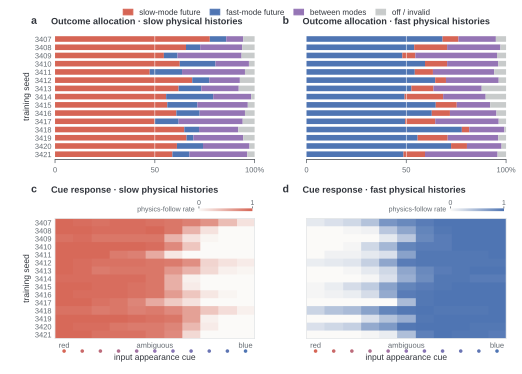
FIGURE 8

Behavior across training seeds

The cue-dependent allocation of generated motion recurs across 15 independently trained models.

Caption and methods in paper ↗
Figure 8: Behavior across training seeds
Pretrained replication3 figures
Controller controls3 figures
Cross-system replication8 figures
Training and writability5 figures
Transfer and downstream mechanisms6 figures
07

Scope of inference

The evidence supports a compact, state-dependent causal route whose availability can be dissociated from its natural causal authority. The route jointly controls appearance and dynamics.

SUPPORTEDState-structured causal accessibility

Alternative continuations remain internally callable even when they do not control natural generation.

NOT ESTABLISHEDA pure physics representation

The results do not imply classical disentanglement, a universal mechanism across solutions, or calibrated model confidence.

Authors and citation

Xingyun Wang*, Haomin Zheng*, Man Yuan, Leqian Yang, Ziming Liu

Tsinghua University · Peking University · University of Science and Technology of China · MetaCircle · Shanghai Qi Zhi Institute

* Equal contribution. xingyun-24@mails.tsinghua.edu.cn · zmliu@tsinghua.edu.cn

@misc{wang2026causalwritability,
  title={A Chosen Future Can Still Be Rewritten: Causal Writability in Video Models},
  author={Xingyun Wang and Haomin Zheng and Man Yuan and Leqian Yang and Ziming Liu},
  year={2026},
  note={Preprint}
}